
Smith County Court Records After Arrest
After a Smith County jail arrest, two record tracks can exist at the same time. The jail track covers custody, commitment, bond or release, and the cause for holding the person. The court track begins when charges are filed in district court. The official county attorney page says the Smith County Attorney prosecutes criminal offenses for the county, works with law enforcement to decide whether charges should be filed, and helps with victim services such as court notifications, restitution guidance, and protective-order assistance.
That distinction keeps court records after a jail arrest from being confused with arrest records or booking records. A jail entry may reflect an officer's allegation, a warrant, or a hold. A court record shows what the prosecutor filed and what the judge and clerk track through the case. For custody and booking detail, use Smith County jail inmate records. For booking-photo questions, use the Smith County jail mugshots page.
The Smith County Attorney page identifies the local prosecutor contact and office hours.

The prosecutor's office explains the charge-filing role, but court-file copies and docket access are still handled through court-record channels.
Find Smith County Court Records
Kansas CaseSearch is the statewide public portal for district court case records. Smith County is in the Kansas 17th Judicial District with Decatur, Graham, Norton, Osborne, Phillips, and Smith counties. If online access is blocked, incomplete, or not yet updated, courthouse access and clerk requests remain the practical fallback. The Kansas Judicial Branch says many court records are open, while sealed or legally restricted records are not public.
- Search Kansas CaseSearch by party name or case number when online access works.
- Open the matching case and compare the filed court charges with any jail cause-of-commitment information.
- Check hearing dates, bond entries, warrants, amended charges, dismissals, and disposition fields when available.
- Contact the Smith County District Court clerk or use courthouse access for older files, certified copies, or records not available online.
The 17th Judicial District page confirms Smith County's district assignment.
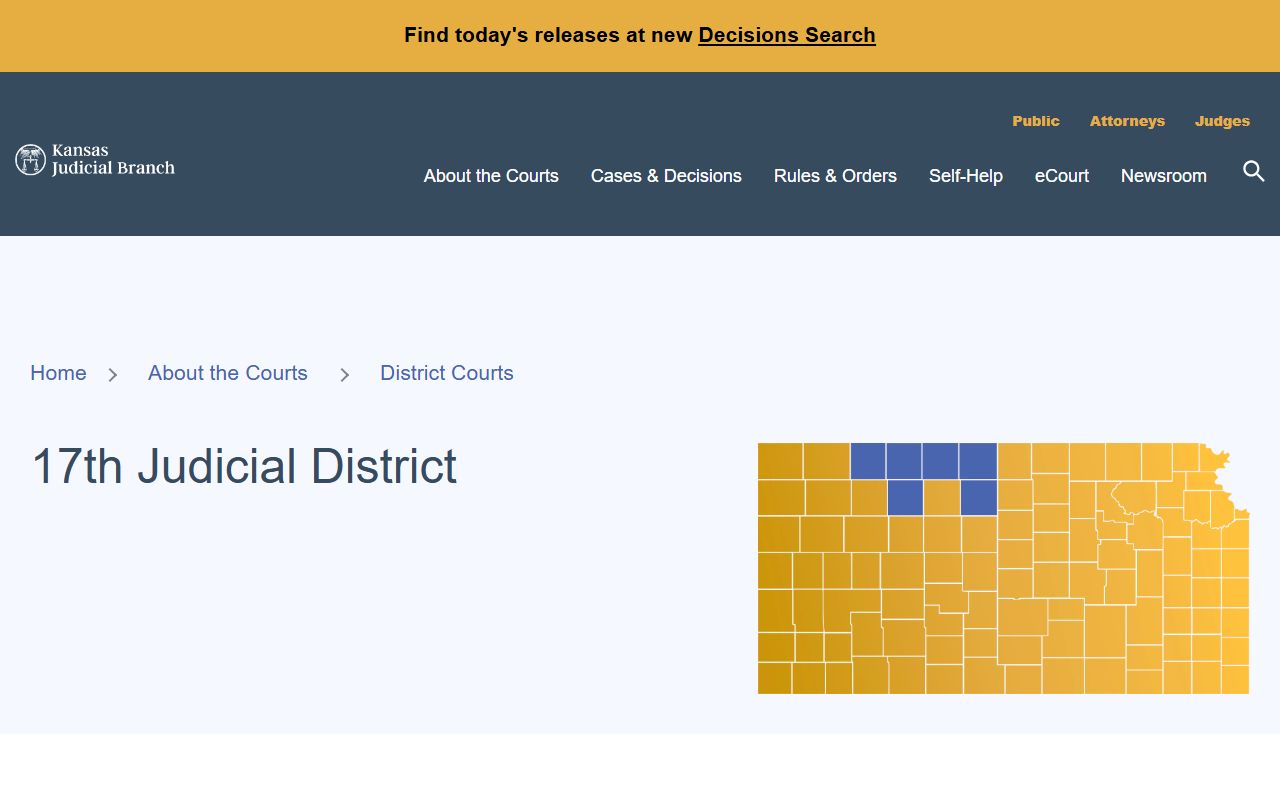
District assignment is useful when a Smith County arrest becomes a case that must be checked through court channels instead of jail channels.
Smith County Case Search Routes
Research did not overstate CaseSearch field details because static terminal access encountered Cloudflare blocking. The official route is still clear: use CaseSearch where available, then courthouse or clerk access when the case is not visible online. The County Attorney is relevant to charge filing, but it is not a substitute for court docket copies.
| Search Route | Fields / Notes |
|---|---|
| Kansas CaseSearch | Public portal for district court case records; use defendant name or case number where available. |
| Smith County District Court / 17th Judicial District | Fallback for older files, sealed-status explanations, certified copies, and records not available online. |
| County Attorney | Source for prosecutor-filed charge role; not the custodian for all court-file copies. |
| KBI criminal history | Fee-based statewide criminal-history search; Kansas.gov purchase price listed as $30.00. |
Charges Filed After Arrest
The court record begins with a charging document, not with the booking photo or the jail intake note. Kansas cases commonly involve a complaint or information, while an indictment is tied to a grand-jury process. The research file does not provide a Smith County sample charging document, so the table stays general and procedural rather than claiming a local form layout.
| Document | Filed By | What It Does |
|---|---|---|
| Complaint | Officer or prosecutor route, depending on case practice | States the alleged offense and can begin the case process. |
| Information | Prosecutor | Lists the formal charges the prosecutor brings in court. |
| Indictment | Grand jury | Charges a case after grand-jury action, usually in more serious matters. |
Smith County Charge Status
Court records after an arrest can change as the case moves. A charge may be pending at first appearance, amended after review, reduced in a plea, dismissed by the prosecutor or court, or resolved by conviction, diversion, acquittal, or another disposition. A jail cause-of-commitment entry should not be read as a final conviction.
| Status | What It Means |
|---|---|
| Pending | The charge has been filed or remains open, and no final disposition appears. |
| Amended | The prosecutor or court record reflects a changed charge, count, or level. |
| Reduced | The charge level or offense may be lowered, often through plea or review. |
| Dismissed | The charge is no longer being pursued in that case, though other counts may remain. |
| Convicted | The court entered a conviction after plea, verdict, or other lawful disposition. |
Bond After Smith County Arrest
The official Smith County Jail page is specific about bond types. Cash bond means the full bond amount is paid in cash to the Clerk of the District Court or Sheriff's Office, with refund after final disposition usually reduced by court-ordered fines, fees, restitution, or other deductions. Surety bond uses a professional bonding agent, and the jail page says the sheriff's office cannot accept a surety bond from a company not approved by the District Court.
| Bond Type | How It Works in Smith County Records |
|---|---|
| Cash bond | Full amount paid to the court clerk or sheriff, subject to later deductions ordered by the court. |
| Surety bond | Approved bonding agent guarantees the amount after a nonrefundable fee, often 10 percent. |
| Own recognizance | Court may release the defendant on a signed promise to appear. |
| ORCD / 10 percent deposit | Own-recognizance release with a court-ordered cash deposit condition. |
| No-bond or hold | Release may be blocked by court order, detainer, parole or probation hold, federal custody, or immigration matter. |
Bond conditions can include court-services check-ins, travel limits, and no-contact orders. The Smith County jail page notes that victim-related charges may carry no-contact conditions for at least 72 hours and often longer.
Warrants and Arrest Records
No official Smith County active-warrant search, sheriff warrant list, or most-wanted page was located. The sheriff page describes court-services duties, including execution of court orders, but does not publish a warrant database. For warrant-related court records after an arrest, search CaseSearch for case activity when available, contact the district court for court-issued bench warrants, and call the sheriff for custody or warrant questions that staff can lawfully answer.
Common warrant terms include arrest warrant, bench warrant, search warrant, fugitive warrant, and probation or parole hold. A bench warrant often follows a missed hearing or court-order violation. A hold from another county, state, federal agency, or supervision authority can keep a person in jail even when the local court has set bond.
Charges vs Convictions
A Smith County arrest and a Smith County court charge are not the same as a conviction. A charge is an accusation filed in court. A conviction requires a plea, verdict, or other court action that results in guilt being entered. Court records may show both, so the status field and disposition matter.
| Charge | Conviction | |
|---|---|---|
| Stage | Accusation after arrest or filing | Final or resolved court outcome |
| Proof | Not proof of guilt | Entered after plea, verdict, or lawful disposition |
| Can Change | Can be amended, reduced, or dismissed | May still be appealed, corrected, or later expunged if eligible |
| Where Seen | CaseSearch, court file, charging document | Disposition or judgment section of the court record |
Sealed and Expunged Records
Kansas uses expungement procedures for certain convictions, diversions, and related arrest records. K.S.A. 21-6614 is the core expungement statute cited in the research file, and the Kansas Judicial Council publishes adult arrest-record-only expungement forms. Expungement is not automatic just because a person wants a booking record removed.
| Sealed / Restricted | Expunged | |
|---|---|---|
| Meaning | Public access is limited by law or court order. | Qualifying record access is limited through statutory expungement. |
| How It Happens | By statute, court order, or restricted record type. | Through a petition or eligible legal process. |
| Who May Still See It | Courts or agencies may retain limited access. | Some government access can remain under Kansas law. |
| Smith County Route | Ask the district court clerk about access status. | Use Kansas court forms or legal counsel for eligibility and filing. |
KBI Criminal History Search
The Kansas Bureau of Investigation criminal history search is a statewide criminal-history route, not a jail roster and not the same as Smith County court-file access. Research found a Kansas.gov purchase price of $30.00 and a maintenance window from midnight to 4:00 a.m. Central, with service otherwise available from 4:00 a.m. to midnight Central. It may require a KanAccess or subscriber path.
Important: Do not use informal jail, court, or custody lookups for employment, housing, credit, insurance, or other FCRA-regulated screening.
Restricted Smith County Court Records
Not every court record after an arrest is public. Juvenile records, sealed cases, expunged records, some victim-sensitive material, and records restricted by court order or statute may not be available through public search. Kansas open-records law also allows closure of criminal investigation records and some correctional or security information. When a case exists but public details are missing, the correct next step is to ask the clerk about access status rather than assume no case was filed.
Smith County readers should also keep custody status separate from court access status. A person may be released from jail while a case remains pending, or may remain held because of a warrant, no-contact bond condition, probation or parole hold, federal matter, or other detainer. Court records after a jail arrest help explain the charge path, but the jail remains the source for current local custody that can lawfully be confirmed.