
Smith County Inmate Population Overview
The Smith County inmate population starts with one local detention facility: the Smith County Jail, operated by the Smith County Sheriff's Department. Official county research located no city jail, regional jail, work-release center, state prison, federal prison, or ICE detention center physically in Smith County. That narrow facility map matters. A person arrested by a Smith County deputy, a Smith Center police officer, or another authorized agency is generally routed through the county jail, court release, transfer, or another lawful custody channel instead of a second local jail.
The current size of the Smith County inmate population is not published in the official county sources reviewed for this build. The sheriff and jail pages provide contact rules, visitation rules, CIDnet communication rules, commissary handling, and bond guidance, but they do not publish a live jail census, bed capacity, annual booking count, or average daily population. Treat that absence as a finding, not as a blank to fill. The count can rise or fall with a few arrests, bond decisions, court holds, transfers, or releases in a rural county.
The official sheriff page identifies Sheriff Travis Conaway and places the sheriff's office on the east side of the courthouse, across from Smith Center Grade School. That office has charge of the local jail under Kansas law. Once a person is sentenced to a Kansas prison term, the Smith County jail count stops being the main lookup point and KDOC KASPER becomes the state locator.
Smith County Inmate Population Statistics
The strongest sourced statistic for Smith County is the absence of a published local jail population table. No official current jail population, rated capacity, annual bookings total, average length of stay, jail demographic split, felony and misdemeanor split, or hold-for-other-agency count was located in county sources. The county's public pages instead document how to contact the jail, visit someone, use CIDnet, handle commissary, and request records through the Kansas Open Records Act process.
| Measure | Figure | Source / Year |
|---|---|---|
| Smith County Jail current population | Not published in official sources found | Sheriff and jail pages reviewed June 2026 |
| Smith County Jail rated capacity | Not published in official sources found | Sheriff and jail pages reviewed June 2026 |
| Smith County Jail annual bookings | Not published in official sources found | No county annual jail report located |
| Smith County 2020 Census population | 3,570 | U.S. Census QuickFacts |
| Smith County July 1, 2025 estimate | 3,566 | U.S. Census QuickFacts |
| National local jail population | 664,200 | BJS Jail Inmates in 2023 |
The Census QuickFacts page for Smith County is a useful county-population source, but it is not a jail-population source. It can help explain scale in a rural county, while the jail count itself still has to come from the sheriff, a jail report, or a valid records request.
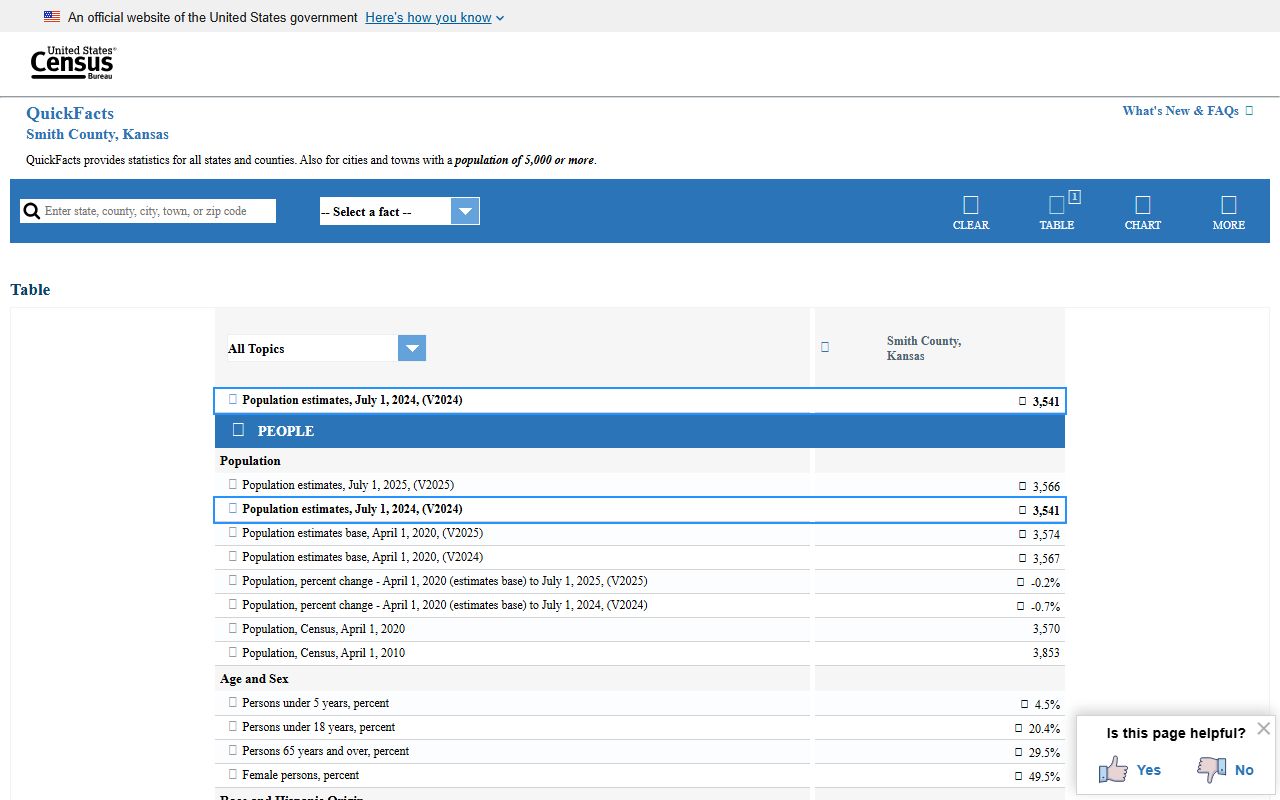
The screenshot supports local population context only. It should not be read as a current jail census or a count of people held at the Smith County Jail.
Smith County Inmate Population Trends
No official Smith County jail dashboard or multi-year average daily population table was located. A quick trend table therefore cannot state that the Smith County inmate population rose, fell, or stayed flat in recent years. The better public answer is that official trend reporting is thin, and any current count should be verified through the sheriff or a KORA request when the request is for a record that can lawfully be released.
| Year | Local Jail Population / ADP | Notes |
|---|---|---|
| 2022 | Not located | No official Smith County jail dashboard or report found. |
| 2023 | Not located | No official Smith County jail dashboard or report found. |
| 2024 | Not located | No official Smith County jail dashboard or report found. |
| 2025 | Not located | No public live roster or census found. |
| 2026 | Not located | County jail page reviewed without a public census field. |
A small jail population can change quickly. One arrest, a no-bond hold, a transfer to KDOC, or a release on an own-recognizance bond may shift the local count in a way that would be minor in a large urban jail. That is why the local jail phone line and formal records route are more useful for Smith County than a stale third-party count.
Smith County Jail Capacity
The official Smith County jail page does not publish a bed capacity, pod layout, housing-unit list, construction year, accreditation status, or current overcrowding figure. No high-authority 2024 through 2026 litigation, consent decree, death-in-custody report, overcrowding order, new-jail construction project, or closure order was located in the research set. That means the Smith County inmate population should not be described as overcrowded or under capacity unless a later official source supports the claim.
Kansas law still sets baseline jail duties. K.S.A. 19-1903 requires jailkeeping, separation by sex except lawful spouses, food, drink, and medical care. K.S.A. 19-1919 addresses humane treatment, juvenile separation, and reasonable visits under jail rules. Those duties are not a substitute for a published capacity number, but they explain the legal floor for local custody.
Smith County Jail Record Laws
Kansas public-record law gives the public several routes to jail information while also allowing some law-enforcement and corrections records to be withheld. For Smith County inmate population questions, the most important distinction is between the jail calendar or custody record, which has strong public-record support, and investigative records or security-sensitive details, which may be closed or redacted.
Key Statutes:
K.S.A. 45-218 requires action on public-record requests promptly, with action no later than the end of the third business day after receipt.
K.S.A. 45-219 allows agencies to charge actual costs for copies, staff time, and related access services.
K.S.A. 45-221 lists records not required to be disclosed, including criminal investigation records and some correctional or security records.
K.S.A. 19-1904 requires the sheriff to keep a true and exact jail calendar with prisoner names, commitment, discharge, cause, authority, and release details.
K.S.A. 19-1935 requires investigation and reporting when a city or county prisoner dies in custody, with statutory limits.
The Kansas Attorney General KORA FAQ also notes that mug shots or standard arrest reports may be closed under Kansas law. That is why the Smith County inmate population pages separate roster-style jail data from booking photos and criminal investigation records.
Search Smith County Inmate Custody
No official public Smith County online jail roster, current-inmate search portal, daily booking report, recent-bookings page, or mugshot gallery was located on county or sheriff pages. The practical search path therefore starts with the jail and then moves outward by custody type. Current local custody is different from state prison custody, federal custody, immigration custody, and court charge records.
- Call the Smith County Sheriff's Department or jail at 785-282-5180 and ask what custody, bond, or booking information can be released.
- For nonurgent records, start with the sheriff and use the Smith County open-records process if a written KORA request is required.
- Use Kansas VINELink for custody-status notifications, release alerts, or transfer alerts.
- Search KDOC KASPER when the person may have been sentenced to state custody or supervision.
- Use Kansas CaseSearch for court charges after filing, not for live jail custody.
- Use the BOP inmate locator or ICE ODLS only for the federal or immigration custody slice.
There is no official Smith County sheriff mobile app documented in the research. Kansas VINE may have mobile access through the VINE system, but that is a statewide notification tool, not a local sheriff roster.
Smith County Roster Fields
Because no public Smith County online roster was located, the county does not publish search fields such as last name, booking number, housing unit, charge filter, released-inmate view, or profile links. The table below preserves that finding. It prevents a reader from wasting time looking for search boxes that the official county pages did not expose.
| Field Label | Type | Required | Notes |
|---|---|---|---|
| No official Smith County online roster located | n/a | n/a | No county search fields, refresh rate, profile links, pagination, or public sample records were published in official local sources found. |
KASPER is different. Its public search can include photo-display choices, name fields, alias search, KDOC number, race, gender, birth date, age range, conviction county, parole supervision county, community corrections location, facility, and supervision type. Those fields are for the Kansas sentenced or supervised population, not the Smith County jail roster.
Smith County Inmate Record Fields
Kansas jail-calendar law supplies the best public field inventory for Smith County inmate records. It does not prove that each field will be handed out by phone, and it does not make a mugshot public. It does show what the sheriff must keep in a true and exact jail calendar when a person is committed to the county jail.
| Field | What It Shows |
|---|---|
| Name | Person committed to the Smith County Jail. |
| Place of abode | Residence or location information required in the jail calendar. |
| Time of commitment | Booking or commitment time into the jail. |
| Time of discharge | Release, transfer, or discharge time. |
| Cause of commitment | Arrest charge, warrant, sentence, hold, or other custody basis. |
| Committing authority | Court, officer, agency, or legal authority that committed the person. |
| Release authority | Bond, court order, sentence completion, transfer, or other release source. |
| Mugshot | Not published online by Smith County in official sources found; Kansas AG guidance says mugshots may be closed as criminal investigation records. |
Smith County Jail vs KASPER
The Smith County inmate population and the Kansas state prison population are linked by court outcomes, but they are not the same database. A pretrial detainee or short local sentence belongs to the county jail side. A sentenced Kansas prison inmate, parolee, postrelease person, absconder, or displayed community corrections status belongs to KDOC KASPER. A federal or immigration case may not appear in either local county jail material or KASPER.
| Custody Type | Search Route | What It Covers |
|---|---|---|
| Local pretrial or short sentence | Smith County Sheriff's Department / KORA | Current jail custody, booking, bond, jail-calendar records, and local release information when releasable. |
| State sentenced or supervised | KDOC KASPER | KDOC-funded or KDOC-operated custody and supervision records, updated each working day. |
| Federal sentenced | BOP inmate locator | Federal inmates incarcerated from 1982 to the present. |
| Immigration detention | ICE ODLS | ICE custody or CBP custody more than 48 hours, searched by A-number or biographical details. |
The KASPER disclaimer page is the right starting point after a Smith County case results in KDOC custody or supervision. It is not a complete criminal history and should not be used alone to arrest someone.
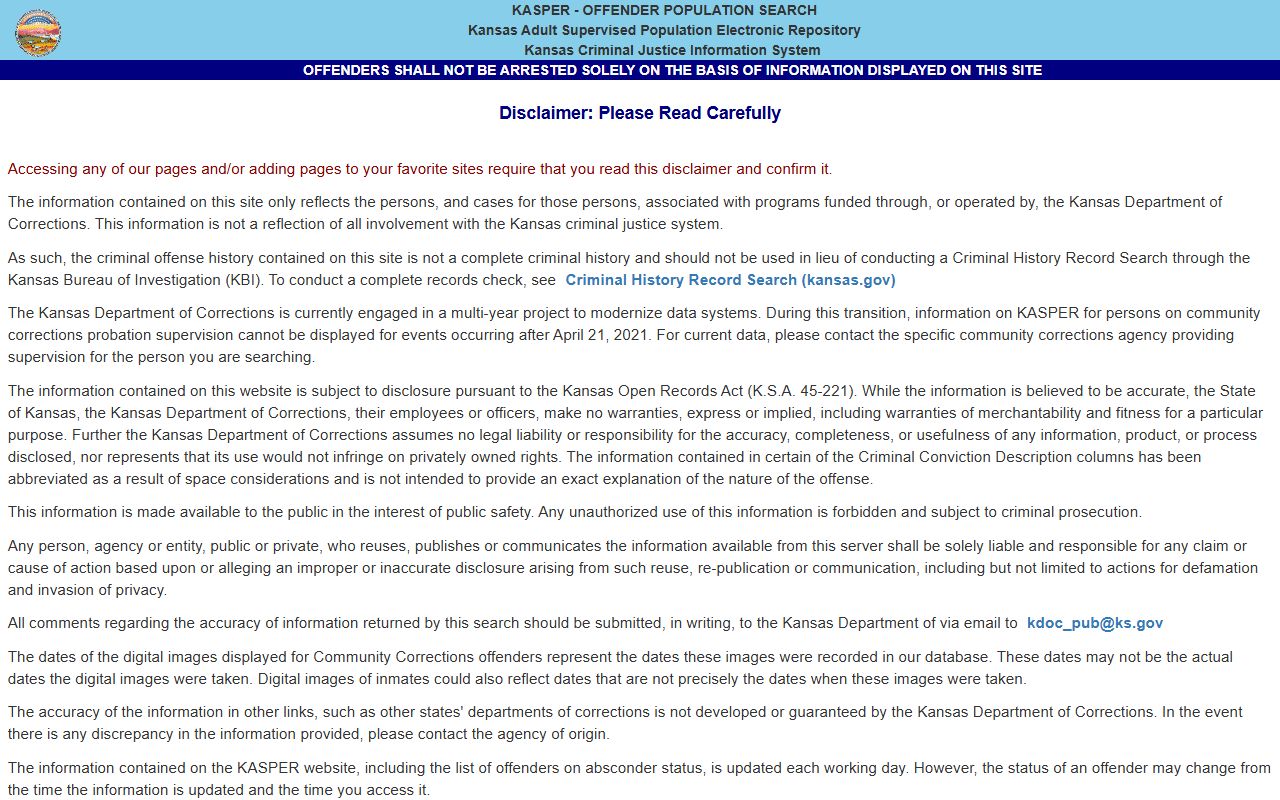
KASPER can help locate sentenced or supervised Kansas offenders, while the Smith County Sheriff's Department remains the local source for county-jail custody questions.
Smith County Detention Facilities
The Smith County facility map contains one local detention site. No Kansas Department of Corrections adult prison, BOP prison, ICE detention center, regional jail, or city jail was located in official Smith County sources. That keeps the local facility list short, but it makes the fallback systems more important.
- Smith County Jail - county jail operated by the Smith County Sheriff's Department for local arrests, pretrial detainees, local-sentence prisoners, warrant and bond holds, and other prisoners lawfully received by the sheriff.
Smith County Jail Context
Smith County's official homepage places the county in a rural north-central Kansas setting. Smith Center is the county seat, the county was organized in 1872, and the geographic center of the contiguous 48 states is in Smith County. The sheriff's office and jail sit near the courthouse in a compact Smith Center government area, with U.S. Highway 36 and U.S. Highway 281 serving as the main approaches into town.
The most useful local jail details are practical rather than statistical. In-person visitation is limited to a Tuesday window. Visits are non-contact through glass using a phone handset. CIDnet handles phone calls, messaging, and video, with data or megabytes rather than traditional phone-time purchases. Commissary is handled by approved physical items brought to the jail, not individual inmate cash books.
The county record route is also local. Smith County's open-records page names the county clerk as the contact for the general request process, while jail-specific questions should start with the sheriff because the sheriff runs the jail. That two-step route matters when a reader wants a jail-calendar entry, bond information, or a copy of a public record. It also helps keep court records, city police records, and county jail records from being mixed together.
Smith County Inmate Population FAQ
How big is the Smith County inmate population?
The current Smith County inmate population is not published in the official county sources found. The jail page does not provide a live count, average daily population, rated capacity, annual bookings, or demographic split. Call the Smith County Sheriff's Department or use a valid KORA request when a specific jail record is needed.
Can Smith County inmates be searched online?
No official public Smith County online jail roster was located. Current custody questions start with the jail phone line. Released or historical booking records may require a written public-records request. Sentenced Kansas custody belongs in KASPER, not a county roster.
Does VINELink replace the jail?
No. Kansas VINELink is useful for custody-status notifications, including release or transfer alerts. It is not a complete booking database, and it does not replace the Smith County Sheriff's Department for jail-calendar records, bond questions, or local custody confirmation.
Where do court charges appear after a Smith County arrest?
Court charges appear through Kansas court records after the prosecutor files the case. Kansas CaseSearch is the public portal when online access works. The county attorney and district court clerk are separate from the jail, so a jail cause-of-commitment entry may differ from the final court charge list.